


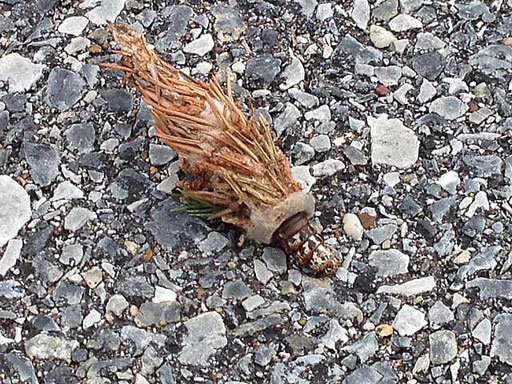
The caterpillar larvae of the Psychidae construct cases out of silk and environmental materials such as sand, soil, lichen, or plant materials. These cases are attached to rocks, trees or fences while resting or during their pupa stage, but are otherwise mobile.
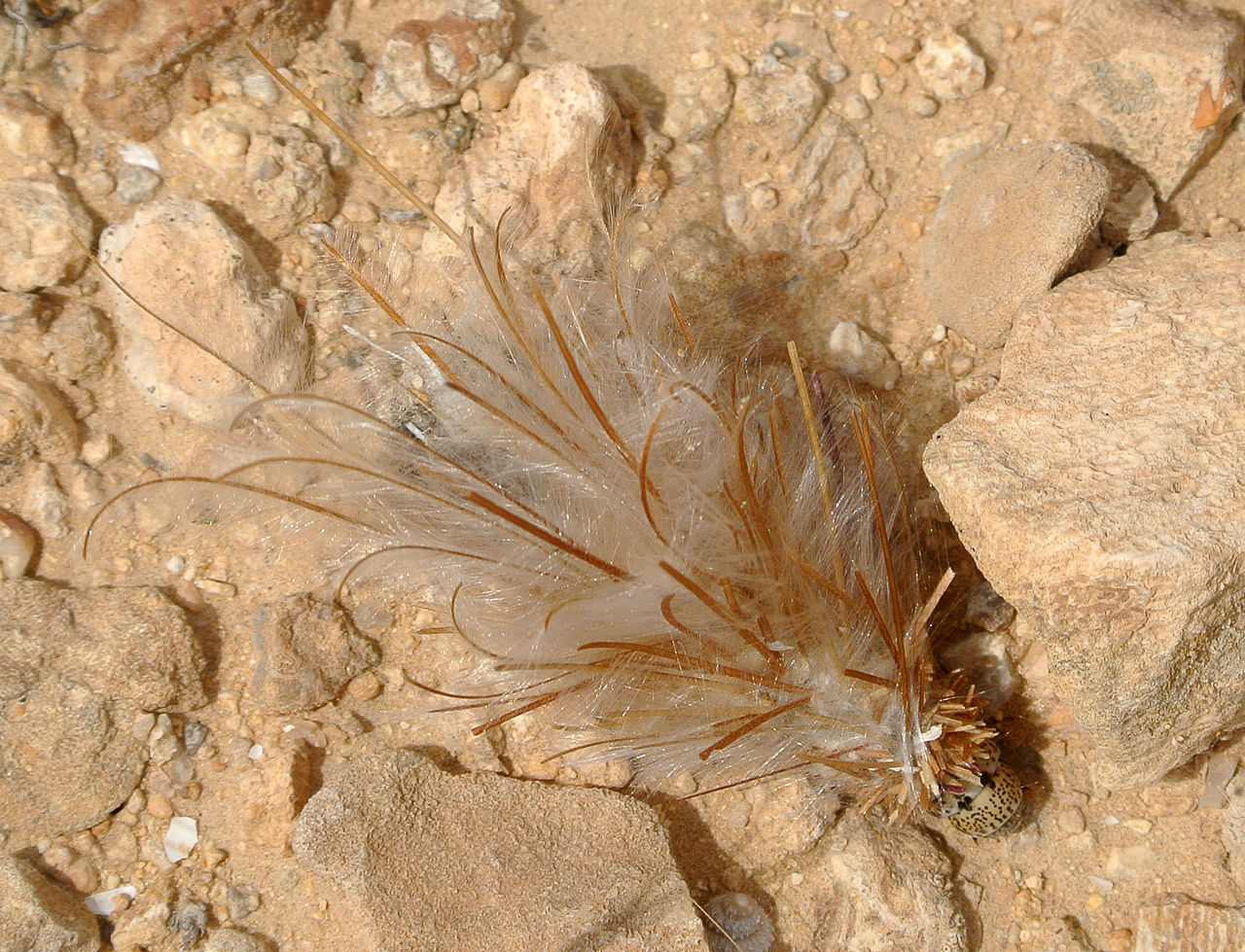 Bagworm larva in the Negev (April 2014). Case is made mostly of feathery stork’s bill seeds.
Bagworm cases range in size from less than 1 cm to 15 cm among some tropical species. Each species makes a case particular to its species, making the case more useful to identify the species than the creature itself. Cases among the more primitive species are flat. More specialized species exhibit a greater variety of case size, shape, and composition, usually narrowing on both ends. Since bagworm cases are composed of silk and the materials from their habitat, they are naturally camouflaged from predators. Predators include birds and other insects.
So we haven’t decided whether our alien has arms or not yet, but if they do I don’t think they’ll be very big as they’re for digging/crawling. I think prosthetic limbs could be an answer to how they developed they’re technology to the point where they could travel to earth through space. Prosthetic limbs that connect to the neural pathways through electromagnetic patches (much like todays latest human prosthetic) and allow the alien to construct and operate machinery or maybe the prosthetic are the machinery.

An 1895 article published in the American Journal of Psychiatry had people rub 51 different cloths and report which type of materials felt pleasant to touch. And a 1937 study suggested that people find smooth and soft fabrics “relaxing.”
More recently in a 2012 study, 123 design students were asked to discuss the kinds of fabrics they liked to touch. The students disliked fabrics that were scratchy, rough or itchy; 41 percent mentioned wool. Coarse, bumpy or cold fabrics were also not popular.
The positive properties that cropped up most often were soft, smooth and warm (some of the runners-up were silky, fuzzy and fluffy). Silk, cotton, and fleece got the highest rankings. The students frequently used emotion-laden words to explain their partialities, such as cozy, cuddly, safe and comforting.
“Cognitive touch properties become more meaningful and memorable when they are linked with effective properties, which combine to satisfy physiological and psychological needs,” the researchers wrote.
It’s interesting to find that universally humans prefer soft, fluffy and warm textiles, I wonder if that has anything to do with the way we’re treated as infants. If our alien has always lived in the ground, we could make the assumption that it prefers warm, dry and crumbly textures. For example dust, dirt, roots, stone even, but once introduced to earth, would they find our textiles appealing? I think they would like muslin and whatever potato sacks are made out of, its got that rough earth feel. They’d need something to protect them from the damp earth.
An example of sensory disorder:
“Most of my things are about touch, usually textures. When it comes to eating any type of soggy bread is a big no-no, I usually avoid sandwiches/subs and burgers because some kind of sauce or oil could have soaked into the bread. Even touching it will make me gag let alone putting it in my mouth, which then I wouldn’t even be able to make myself swallow the food. Bread or croutons dipped in soup, cookies dipped in milk type things absolutely gross me out just by looking at them because ill feel/imagine the texture in my mouth. Cant do ‘soft chunks’ of foods: chunks in salsa or pasta sauces with tomato, onion etc chunks. Mushrooms raw or cooked, cooked onion is the worst feeling after the soggy bread…
I cannot stand wet hair, it grosses me out to touch or to feel my hair being touched by someone else while wet. Anything that feels rough/dry/cracked or bumpy I cannot help but pick at/rub over constantly. I avoid some types of… dry feeling fabrics? It feels uncomfortable to touch softer paper napkins/kleenex and after using them I have to rub my fingers together or on something else to get rid of the feeling. Sometimes I get the feeling in my mouth as if i was chewing on napkin, grinding it between my teeth… and that’s just not a pleasant feeling haha. Takes forever to get rid of the sensation. Whispy, fluffy types fabrics, like cotton balls or cotton stuffing, those foam mats you put over your mattress are all veryyyy unpleasant.” – source
Misophonia, literally “hatred of sound,” was proposed in 2000 as a condition in which negative emotions, thoughts, and physical reactions are triggered by specific sounds. It is also called “select sound sensitivity syndrome” and “sound-rage.”
Maybe of our alien doesn’t make much noise, it has a hatred of other sounds, this condition is quite rare in the human populas, but came up while I was researching reactions to different textures. It turns out sufferers don’t actually have to hear the sound trigger, just seeing someone touch or do something that emits the sound can trigger a sufferer of misophonia, like imagining nails on a chalkboard or seeing someone rub bits of polystyrene together.
Eco-fiction is ecologically oriented fiction, which may be nature-oriented (non-human oriented) or environment-oriented (human impacts on nature).
“The terms ‘environmental fiction,’ ‘green fiction,’ and ‘nature-oriented fiction,’ might better be considered as categories of ecofiction….[Ecofiction] deals with environmental issues or the relation between humanity and the physical environment, that contrasts traditional and industrial cosmologies, or in which nature or the land has a prominent role…[It is] made up of many styles, primarily modernism, postmodernism, realism, and magical realism, and can be found in many genres, primarily mainstream, westerns, mystery, romance, and speculative fiction. Speculative fiction includes science fiction and fantasy, sometimes mixed with realism, as in the work of Ursula K. Le Guin.” -Jim Dwyer [Ibid. Chapter 2.]
The branch of human-caused climate change in eco-fiction has grown considerably since it began in the 1970s. Dwyer called climate change novels cautionary or disaster fiction. These days, a multitude of newer terms have attempted to wrap their arms around the hyperobject that is anthropogenic global warming (AGW), or what one might call the biggest eco-crisis of our times, perhaps what all other prior concerns in eco-writings have led to, built upon, and culminated in. Such specific genres include Anthropocene, climate, enviro-horror, afrofuturism, green, nature-oriented, eco-futurism, eco-punk, biopunk, environmental science, environmental, and ecological/new weird fictions, to name a few–and these do not always relate just to just climate change but to a broader ecological and eco/socio system. A hyperobject, according to Timothy Morton, explains objects so massively distributed in time and space as to transcend localization, such as climate change.

Are they really a Hive Mind?
Well that depends on your definition of a hive mind, bees are not telepathically linked, but they can communicate over long distances through scent. Queen bees have a certain scent that attracts all the workers to create a new hive, and worker bees will scent pollen filled flowers to attract others. They also communicate in closer range through ‘dance’ like movements.
Honey bees fly from their colony looking for nectar and pollen. When they are successful in locating good food supplies, they then return to their hive and performs a dance on the honeycomb. At first, the bee walks a straight line while shaking its abdomen vigorously. The bee also makes a buzzing sound with its wings. The speed and distance of the movement conveys the distance of where the food source is so other bees can find it. Communicating the path to follow is more complex because the bee performing the waggle dance talk will align their body in the exact direction of where the food is in accordance with the sun. The dance pattern looks like a figure-eight, as the honey bee keeps repeating the straight part of the movement every time it circles back to the center area again.
An insite to the different roles in Honey bees, also the mutualism in a working hive. –CH
Organisms that operate in a ‘cooperative brood’. Bees, ants and termites are ‘eusocial’. It is considered the “the highest level of organization of animal sociality”, where labour is distributed and offspring is raised by a colony rather than individual parent. Eusociality typically involves ‘endogomy’ which is the practise of only marrying/mating with others of the same race. Species in a eusocial group do not stray from their group to breed with individuals from beyond their group. Naked mole rats are a mammal example of animals that live in eusocial groups, they too have a queen who is primarily responsible for reproduction, but it means that the creatures are quite inbred. To reduce inbreeding, they will occasionally establish new colonies with outsiders.
 Alien-ic Project